
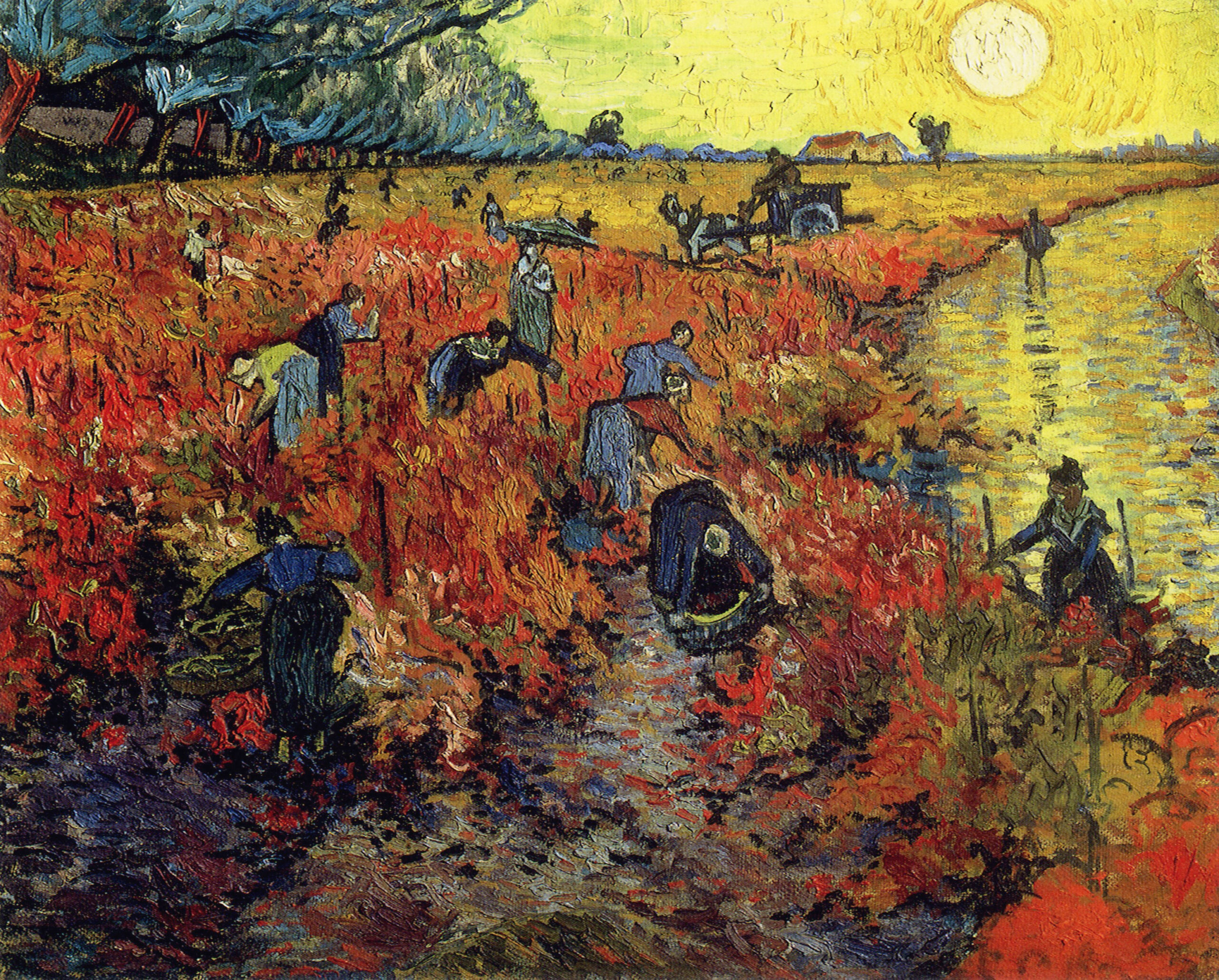
Although his Portrait of Dr Gachet sold at auction for $75, 000,000 in 1990, during his own lifetime Vincent Van Gogh (1853-1890) endured a spectacularly unsuccessful career. In eleven years of painting he managed to sell just one picture: The Red Vineyard, a depiction of harvesters at work near the Provence town of Arles, where he lived for 15 months.
Wine was certainly an important part of Vincent’s life, fuelling his prodigious work rate. In Arles he painted over 200 canvases, in addition to producing 100 drawings and writing 200 letters. He drank copiously, as suggested in a letter that he wrote in April 1889: “Everyday I take the remedy that the incomparable Dickens prescribes against suicide. It consists of a glass of wine, a piece of bread with cheese and a pipe of tobacco”.
Having left Paris abruptly, Vincent arrived in Arles, 700 miles from the capital, by train on 20 Feb 1888. The weather was unexpectedly harsh; instead of the sunshine that he had come to Provence for he was instead greeted by snow.
In April Vincent met the American painter Dodge MacKnight (1860-1950), who was living in the nearby village of Fontvieille.
Two months later MacKnight introduced Vincent to the Belgian writer and painter Eugène Boch (1855-1941). It was Boch’s sister Anne – also a painter – who bought The Red Vineyard in Brussels, for 400 francs, in February 1890, following a show of six Van Gogh works at the Les XX exhibition, which also included paintings by Cézanne, Renoir and Toulouse-Lautrec, amongst others.
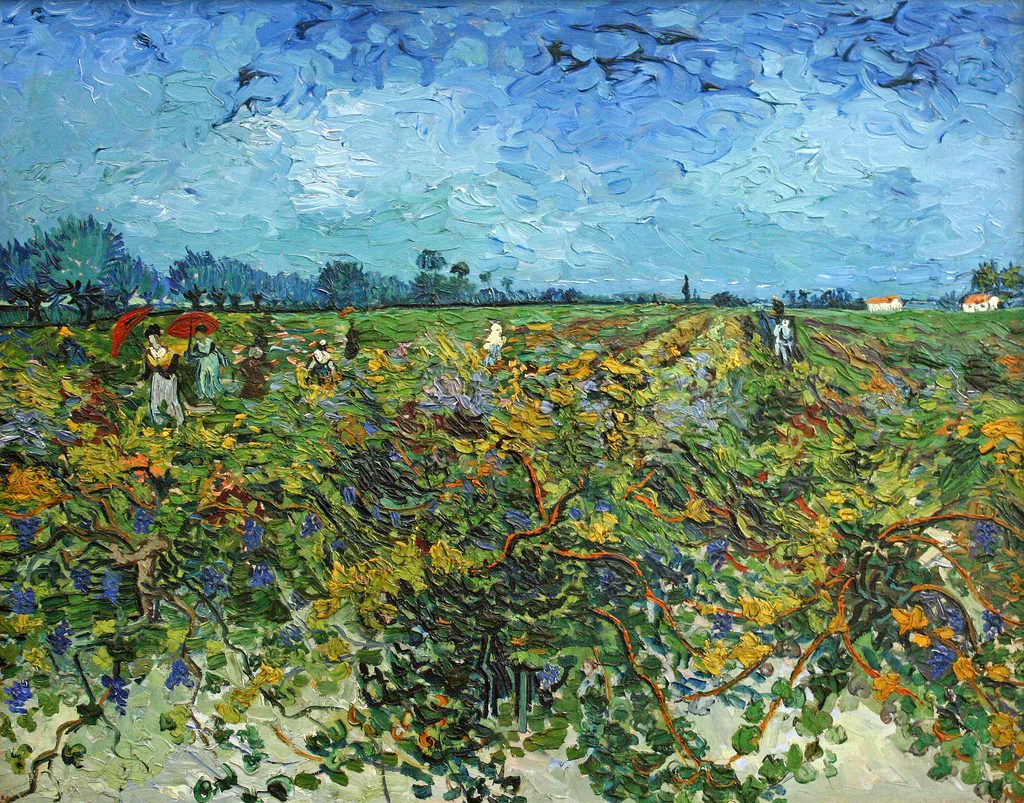
On 23 October 1888 Gauguin, after repeated requests, finally arrived in Arles to live with Vincent in the famed Yellow House. Throughout November 1888 the two painters lived and worked together. When the weather was bad – Gauguin had seemingly brought the rain with him from the north – they painted from memory, or de tête. After a stroll one Sunday evening, when they had been living together for 13 days, Vincent painted The Red Vineyard, having earlier painted The Green Vineyard.
Usually Vincent painted only what was in front of him – “I always do my work on the spot”, he asserted – but The Red Vineyard was most likely painted from memory. Although Vincente Minneli’s 1956 biographical film Lust for Life depicts Vincent painting on the spot, battling against le mistral (and Gauguin), with the vivid brushstrokes on the canvas also implying that the painting was done en plein air, the evidence in the two painters’ letters points towards the picture being completed indoors. Vincent spent several days working on The Red Vineyard – and this was the man who could do a portrait of Madame Ginoux in an hour.
Gauguin wrote a letter to Theo dated 16 November 1888, claiming that “…I have done a painting from memory of a really bewitched poor wretch in the middle of a red vineyard, and your brother who is very generous thinks it’s good”.
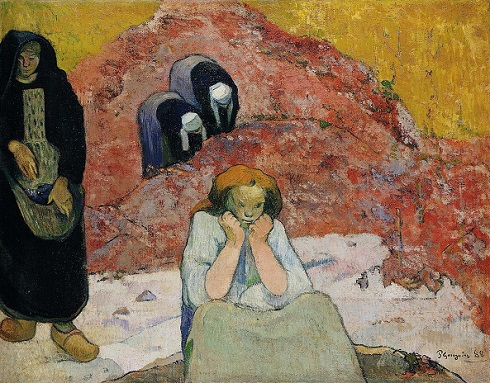
Vincent also wrote to Theo in November and referred to Gauguin having done a painting of women in a vineyard “from memory” (The Wine Harvest / Human Misery), also mentioning that he was himself working on his own vineyard painting, ‘a red vineyard, all red like red wine. In the distance it turned to yellow, and then a green sky with the sun, the earth after the rain violet, sparkling here and there where it caught the reflection of the setting sun’.
The two painters were evidently working together closely, even sharing the same coarse sackcloth canvas that Gauguin had brought with him. The Red Vineyard measures 75 by 93 centimetres, a standard canvas size at the time (‘size 30’), and many of Vincent’s other pictures are the same size.
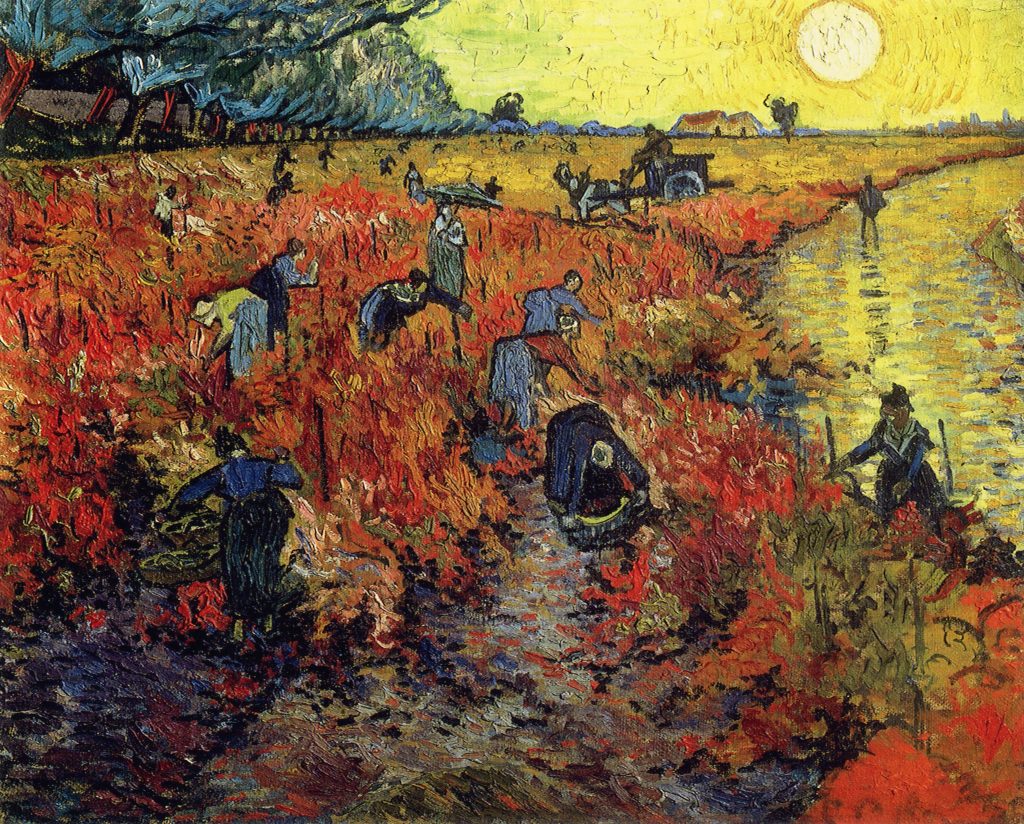
The painting depicts very rustic viticultural practices: a flat, north facing vineyard, planted with sprawling gobelet vines trained up poles; horse-drawn carts; wooden baskets; hand picking; and women harvesters. The woman on the right looks like Madame Ginoux.
The low sun, the yellow sky and the shadow cast by the male figure on the road suggest an evening view. Rain is hinted at on the shimmering road and muddy brown areas between the vines. The low horizon, cropped trees and exaggerated foreshortening of the vineyard create a sense of claustrophobia and hard work. Judging from the painting and Vincent and Gauguin’s letters, the 1888 Arles vintage was evidently tainted by rain and harvested very late in mid November. Grenache and carignan both ripen very late, with very high vigour. These are probably the varieties painted by Vincent.
No appellation for French wines existed in 1888, but today Arles’ vineyards form part of the IGP Pays des Bouches-du-Rhône that covers rustic red, sometimes rosé, and very rarely dry white wine styles. Arles is on the River Rhône, which now represents the boundary between the two wine areas Bouches du Rhône and du Gard, and separates the town from the AC zones of Clairette de Bellegard and Costières de Nîmes to the west. The Tarascon road to Montmajour, which Vincent often walked with his friend Second Lieutenant Milliet, is north of Arles and was Vincent’s preferred route out of the town into the surrounding countryside and probably where he found the vineyard.
Although viticulturally accurate, the vivid colours of The Red Vineyard are also in keeping with Vincent’s symbolic rather than literal use of colour in his work. “All reality is at the same time symbolic”, he believed, and the landscapes that he painted during his stay at Arles became increasingly psychological, his work forming a metaphor of his mental and spiritual state.
The vivid yellow sky is atypical of Vincent’s Arles landscapes – the sky is normally painted in a brilliant blue. Red and yellow are the dominant colours of The Red Vineyard, and a fine example of how Vincent disregarded the established laws of contrasting colour theory. The influences of Impressionism’s pure colour and the individual brushstrokes of Seurat’s pointillisme are both felt in the painting. Vincent’s renowned impasto technique is also apparent, with huge globs of still wet paint smudged into each other. The absence of a signature on the canvas is a reflection of his uncertainty during this period.
After Vincent had sent some paintings – including The Red Vineyard – to Theo, Gauguin wrote to Vincent from Paris on 9 January 1889 that “the picture of the grape harvest has totally flaked because of the whiting, which has separated. I’ve stuck it down again completely…”
After a rapid deterioration of his health and well-being Vincent, on the advice of his brother, went to Auvers sur Oise, near Paris, where Dr Gachet (of that portrait) tended him.
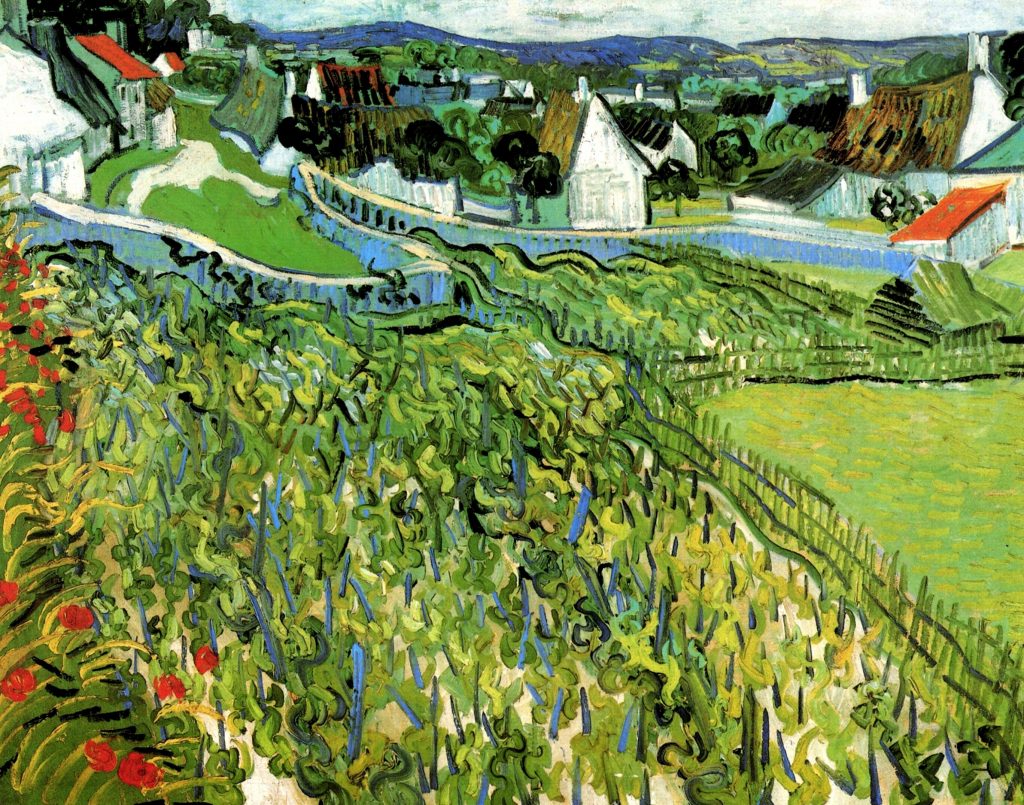
One of Vincent’s final canvasses was Vineyard with a View of Auvers, completed in June 1890. Curiously, it is the most joyful of his three vineyard paintings, showing a small vineyard overlooking whitewashed cottages.
Vincent shot himself on 29 July 1890, just 20 months after painting The Red Vineyard and only five months after it was sold.
Theo Van Gogh died the following year and Gauguin left France for Tahiti.